
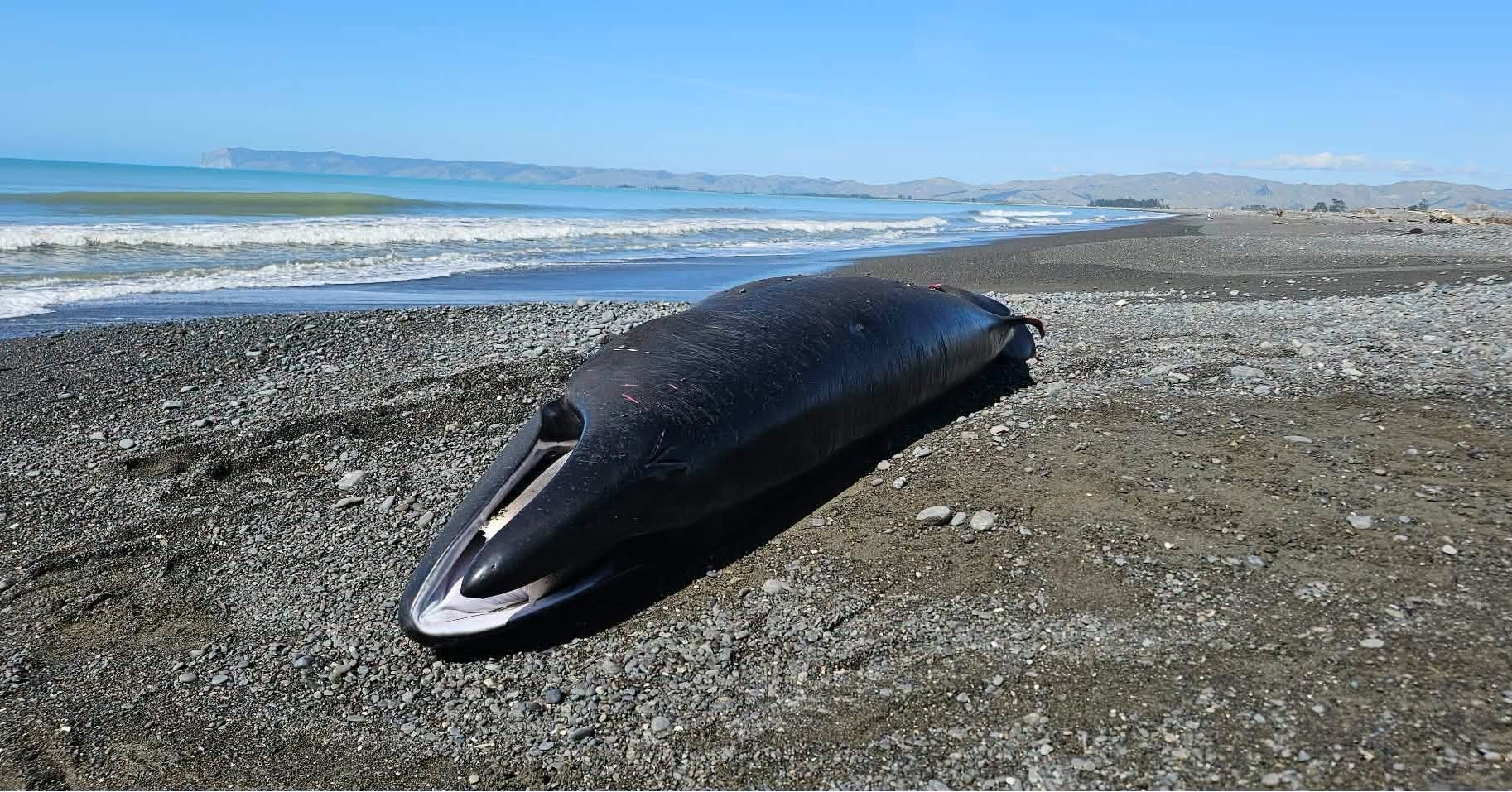
Two pygmy right whales have stranded on South Island shores within weeks of each other, prompting questions over whether the events are linked and offering researchers a rare chance to study the elusive species.
Pygmy right whales are thought to be the rarest species of baleen whale and strand in New Zealand once per year on average, making the double stranding an unusual occurrence.
According to DOC, the first was a 3.6 metre juvenile female near the Wairau Diversion on 14 September and the second was a 5.2 metre adult female on Farewell Spit in Golden Bay on 29 September.
DOC South Marlborough Operations Manager Stacey Wrenn says, on the species, “they are found across the southern hemisphere but are very cryptic, not often being seen at sea, so a lot of what we know about them is from strandings.”
DOC Golden Bay operations advisor Shane Butland says, “it’s unusual to have two so close together. There’s nothing to suggest these are linked at this stage.”
Researchers from Massey University’s Cetacean Pathology Unit carried out necropsies on both animals under the guidance of Rangitāne o Wairau and Manawhenua ki Mohua, following appropriate tikanga.
While the findings from the second whale haven’t been revealed, the necropsy from the animal found on Marlborough shores suggests early evidence of nutritional stress, based on findings in the animal’s pancreas, according to Professor Karen Stockin, Research Lead of the Cetacean Ecology Research Group at Massey University.
“Whether that’s because the calf has been separated too soon and not been able to find adequate feeding on its own, or whether or not there’s a shortage [of food], that’s two different things. We don’t know the answer,” she explains.
She adds that krill and sediment was found in the animal’s stomach, and further investigation will be done to assess its diet.
“If it’s struggling to find food of its own, it’s not uncommon that it will eat all sorts of things, [where] it’s just trying to get something in the stomach.”
Karen explains that while the cause of the animal’s nutritional stress currently remains unknown, the second whale could help draw more conclusive answers.
With the second animal being fully grown and likely unreliant on the mother’s milk, Karen explains:
“We would be interested to see what we find in the stomach of that one, and if we start to see similar changes in the pancreas that suggest that animal is also under some kind of nutritional stress, then we would probably be starting to question whether or not this is more of a food availability issue rather than failed weaning evidence.”
