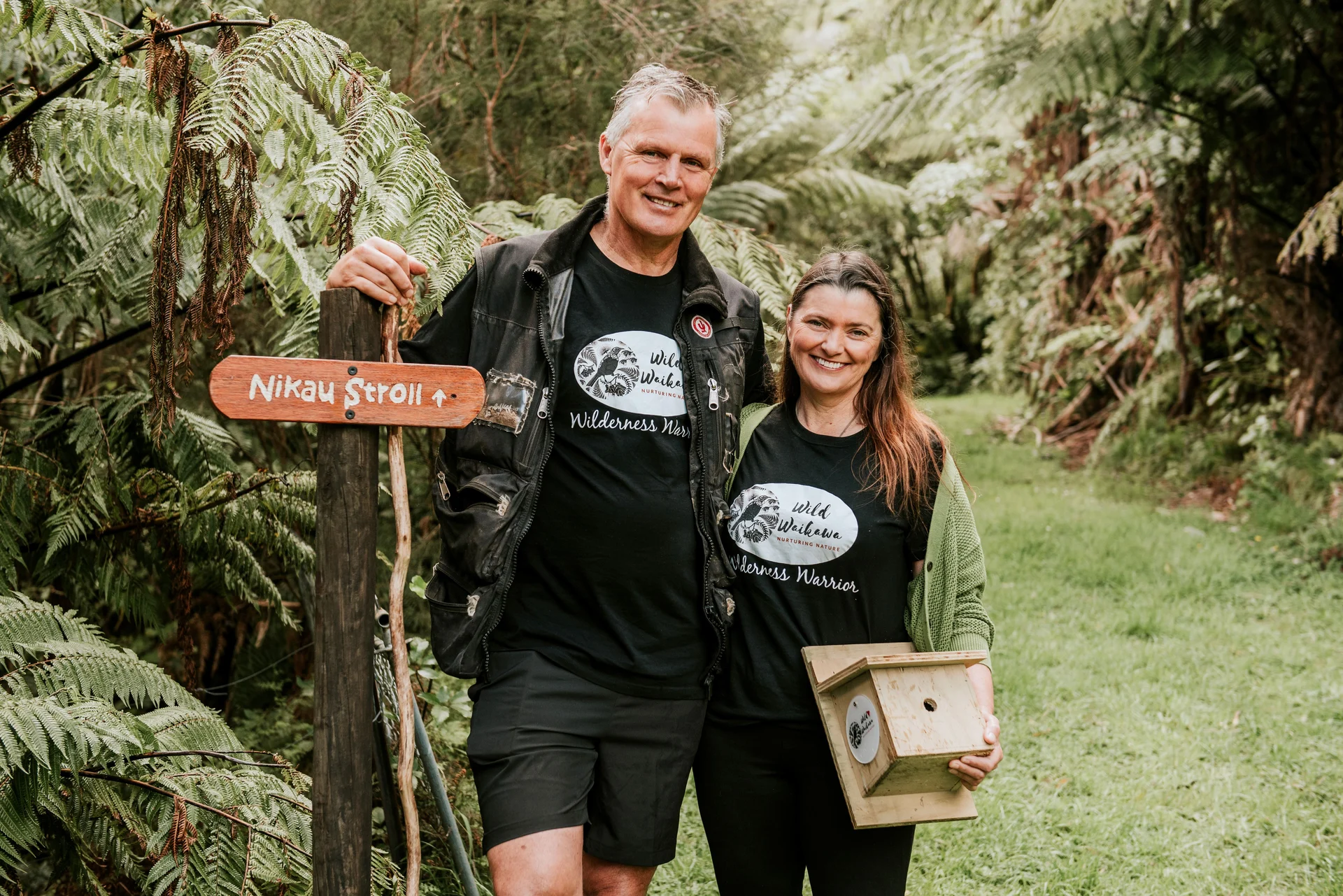
At the end of a muddy road in Waikawa, an ambitious restoration project is taking shape, guided by a vision that stretches at least 400 years into the future.
Words: Rachel Enright | Photos: Aimée Preston
Deep in Boons Valley, an ambitious restoration project is bringing a native forest back to life. But at Wild Waikawa, restoring the land is only part of the story.
I arrive at Wild Waikawa expecting to spend an hour learning about a community conservation project.
The drive from Blenheim is an easy one, but as Boons Valley Road winds further into the valley and the muddy road stretches on, I find myself checking Google Maps more than once, wondering if I should still keep going. Just as I begin to question it, I arrive.
Michelle is waiting for me with a big smile.
Before we even step inside, she begins talking about where we are standing, to give me the lay of the land, literally and figuratively.
Pointing across the valley, she explains how this precious whenua includes Te Maunga o Piripiri, the sacred mountain of mana whenua, Te Ātiawa o Te Waka-a-Māui. She traces the rivers flowing from the surrounding mountains and talks about the significance of the landscape long before Wild Waikawa ever existed.
A light drizzle sends us indoors, where a warm chai latte replaces the cool valley air. Michelle begins sharing the story of how she and Nigel came to live at the end of Boons Valley.
It wasn't with grand conservation ambitions. Michelle had imagined running forest bathing and ecotherapy retreats. But when they arrived, they quickly realised the land needed help first.
Goats had stripped the undergrowth. Possums had damaged the canopy and the birdsong was eerily absent. Natural regeneration was struggling.
So they started doing something about it. First, it was just the two of them, then friends and family, and then community started to flow in.
Six years later, that decision has grown into an ambitious community-led restoration project covering a 200-hectare ‘Significant Natural Area’. More than 18,000 native plants have been established, over 23 kilometres of tracks built by hand, and birdlife has increased from just eight recorded species to 28 including the rarer species of kārearea, tītipounamu (rifleman), pīpipi (brown creeper), koekoeā (long-tailed cuckoo) and more. Other vulnerable species repopulating the area include two carnivorous snails, aquatic species like shortjaw kōkopu, and so many insects.

Michelle and Nigel don't see themselves as the ultimate guardians of this place. That role belongs to Te Ātiawa as mana whenua. Instead, they see themselves as custodians with an opportunity to help restore what has been lost.
It is work that has recently earned Wild Waikawa and its community of volunteers the 2026 Environment and Conservation Award at the Volunteer Marlborough Awards, following recognition at the 2025 Port Marlborough Environment Awards.
About an hour into my visit, Nigel appears after feeding the chooks, his loyal conservation dog Ash close behind. Before long, he's looking at my shoes with a grin.
"Where are your gumboots?"
Our mode of transport for the next few hours is a quad bike, Ash the dog squeezed in alongside me, stopping at various points before setting off on foot along handmade tracks and stairs disappearing into the bush. Every stop reveals another part of the story.
Nigel points out predator traps beside the track and explains the intensive work required to suppress stoats, rats and possums. Elsewhere, he points to tiny native seedlings emerging from the forest floor.
"This is the kindergarten of the forest," he says.
From a distance, the bush looks healthy enough, but beneath the canopy a new generation is taking hold. And this isn't simply about planting trees.
The long-term goal is to prepare the ecosystem for conservation translocations, eventually returning native birds and other species that once inhabited this land. They are starting the process to apply to introduce toutouwai (South Island robin) and yellow-fronted kākāriki.
“We are very lucky in Waitohi/Picton. We have amazing restoration work being done by Te Ātiawa Iwi, Picton Dawn Chorus, Kaipūpū Sanctuary, Marlborough Sounds Restoration Trust, Arapaoa Kiwi Trust , Pest Free Ngakuta Bay and more. With so many hands, we have the opportunity to emulate the success of our friends at Zealandia,” says Nigel.
Predator control, planting and natural regeneration are all laying the groundwork for something neither Michelle nor Nigel expects to see completed in their lifetime.
"Our mission spans 400 years, which is the mature age of our tawhai/beech trees," Nigel says.

It's difficult to comprehend a conservation project measured in centuries, but perhaps that's the point. Wild Waikawa is about doing the work now that someone else will inherit. And increasingly, those doing the work are young.
Last year around 325 volunteers contributed almost 9,000 hours, with young conservationists forming a significant part of the Wild Waikawa community. The property has become a place for students and graduates to gain the practical experience that can be difficult to find when starting a conservation career.
One of them is 2026 NMIT work-placement student Mariah Hitchens, who Wild Waikawa nominated for Outstanding Youth Volunteer. Mariah was runner-up for the award, went on to receive three job offers and accepted a six-month Department of Conservation contract trapping feral cats to protect birdlife on Rakiura Stewart Island.
This recognition follows on from Sophie Whittall winning the Outstanding Youth Volunteer and Volunteer of the Year Award in 2025 for her volunteering at Wild Waikawa. Sophie is from Blenheim, was head girl of Marlborough Girls College, graduated from Otago Uni in Ecology and Fresh Water Science, and is now working as a conservation ranger, and studying her master’s degree.
‘We love mentoring young people who care about the environment, supporting their practical confidence early in their careers and being enthusiastic referees for their first jobs,” Michelle says.
That community role and mentorship continues to grow. In the last month alone, Wild Waikawa has hosted local and international volunteers, as well as NMIT kaitiaki students, Tuia rangatahi, Marlborough Boys College, Marlborough Girls College, local secondary school students, visiting conservation organisations and an Australian environmental science student, combining practical work in the nursery, weed control, trapping and trail building with a chance to learn from the land itself.


To Michelle and Nigel, it is important to acknowledge the collective effort of many, “We want to thank those who have stood beside us since our very first steps. Waikawa Marae, Te Ātiawa, Mike Aviss and the team at Marlborough District Council and the Department of Conservation. Without their support and encouragement, we simply could not achieve what we do and we are very grateful.”
Michelle believes that connection matters just as much as the work. Later, while walking through a circle of tall trees, she invites me to pause.
We stand with our backs against the trunks as she guides me through a short meditation. She encourages me to notice the birds, the river, the breeze and simply be still for a moment. It's something she also shares with volunteers, encouraging people to connect with the place they're working to protect.
That sense of connection helps explain why Wild Waikawa has attracted support far beyond those who physically make the journey up Boons Valley. Selected from 800 applicants for the MA Earth collective funding campaign, the project went on to raise $54,000 for its restoration work and finished among the top five of 201 participating global projects for both donor numbers and funds raised. “We feel so incredibly grateful and humbled by this result, and it has come at such a pivotal time as we expand to meet demand,” says Michelle.

Eventually Nigel takes me down another track to where two rivers trickling from the mountains converge. He encourages me to drink from both before leaving me to spend a few minutes there alone. It's a quiet, deeply peaceful spot.
On the walk back, Nigel tells me that long before Wild Waikawa, he was a journalist. In fact, he began his career as a cadet at the Marlborough Express, before a series of careers took him around the world. Then he asks a question.
"Do you want to hear the latest thing I've written?"
“Of course”, I say as he pulls out his phone and presses play. I was expecting to read an article of his, but it's a song called Wild Waikawa.
So we stand side by side looking towards the mountain, mist drifting through the valley and birds calling around us, listening to the words Nigel has written about this place.
What was meant to be an hour has become half a day.
Neither of us seems in much of a hurry to leave.
