
Council’s Infrastructure and Community Facilities Committee has approved funding of $619,000 for seven projects, including the upgrading of three netball courts at Lansdowne Park.
All projects will be funded from Council’s Land Subdivision Reserve fund.
Committee chair Councillor Brian Dawson said developers paid levies to Council when developing a new subdivision which allows for future growth, such as playgrounds and community halls.
“The purpose of development contributions is to enable Council to recover from developers a fair, equitable and proportionate amount of the cost of capital expenditure, necessary to service growth over the long term,” he said.
Money from that fund - the Land Subdivision Reserve - is allocated to eligible sporting, recreation and open space projects that respond to growth-related demand.
The projects presented to the committee were assessed as eligible because they provide new or improved reserves or community infrastructure required to meet demand generated by subdivision, residential growth or increased recreation use.
Funding for the netball courts is $220,000 while the Blenheim wayfinding expansion project received $100,000 to upgrade signage and mapping boards to direct people into the town centre. The same amount went to Shelley Beach north for new revetment improvement works heading towards Bob’s Bay.
The Waikawa Bay Foreshore Reserve received $70,000 to enable the development plan to be implemented, providing safe swimming areas, dinghy storage and launching for small craft.
Other projects include $51,000 for park benches and footpaths in the Wai Iti subdivision, $48,000 for a new footpath in Manor Park and $30,000 for new signage, seating and interpretive signs in Victoria Domain.
The decision is subject to ratification at the full Council meeting on 29 October.
Marlburians of all ages are making the most of competitions to promote the revitalisation of Market Street in Blenheim.
Business Trust Marlborough (BTM) has launched ‘Shop & Win’ – a promotion designed to stimulate trade for participating retailers in the town centre. The organisation has been working with Council to support town centre businesses while construction as part of the Market Street Revamp continues.
“With a major section of Market Street now reopened to vehicles, we thought this the perfect time to entice shoppers back into town to support local,” Beth Barnes from
BTM said.
Shoppers who make a purchase in the town centre at a participating business, simply write their name, email and phone number on the back of their receipt and put it in the official Shop & Win entry box in store.
The promotion runs until Sunday 20 December and features a major prize of a $4,000 travel voucher donated by World Travellers in Blenheim, as well as spot prizes drawn at random throughout.
The full list of retailers and cafés taking part is available at: www.businesstrustmarlborough.co.nz/shop-win
Meanwhile, plenty of youngsters have also taken part in a colouring competition for the Market Street Revamp, run by contractors Fulton Hogan alongside the street upgrade.
Councillor Brian Dawson and Deputy Mayor David Croad along with Eva Edwards from Fulton Hogan had the tough job of choosing the winners.

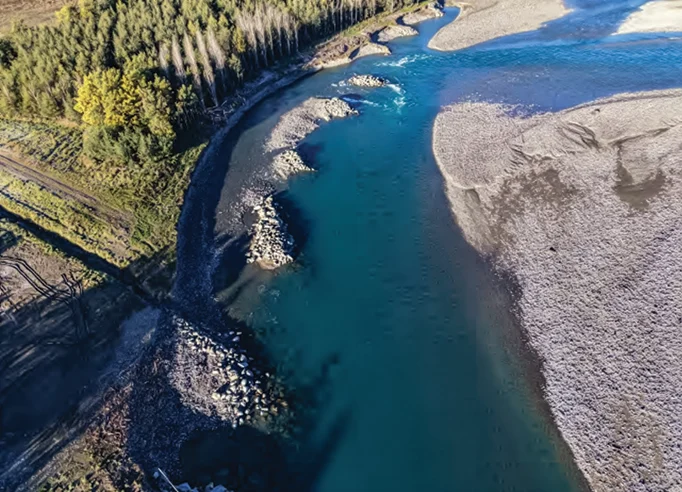
Two large winter rainstorms caused significant damage in the Waihopai, Wairau and Omaka river systems in June and July this year.
Council’s Infrastructure and Community Facilities Committee heard the repair bill was estimated to cost $4.6 million.
Rivers Operations Manager Gregor Punzel said Marlborough’s river flood protection systems of stopbanks and other infrastructure performed well during both events, but there was significant localised erosion and damage at several locations.
“The two significant rain events occurred over a relatively short period of time,” he said. “The June event primarily affected the Wairau River catchment while the July rain caused flooding across southern Marlborough in the Omaka and Taylor rivers.
“The most significant damage occurred along the lower Waihopai, Wairau and Omaka River systems in particularly the stopbank at the Waihopai-Wairau confluence. There was significant erosion of the buffer area as well as the stop bank itself – increasing the vulnerability of the main stop bank.”
While some repairs have been carried out, further repair works were needed as soon as practicable to reduce the risk of further erosion and damage to critical stop bank infrastructure.
Mr Punzel said the rain caused the largest flood levels in both the Omaka and Ōpaoa rivers and the second largest in the Taylor River since monitoring began.
“The stop bank system through Blenheim comfortably managed the July flood flows however, some localised damage occurred including bed scour and degradation,” he said.

