
WENDY SIMONSEN
Archives Manager, Marlborough Museum
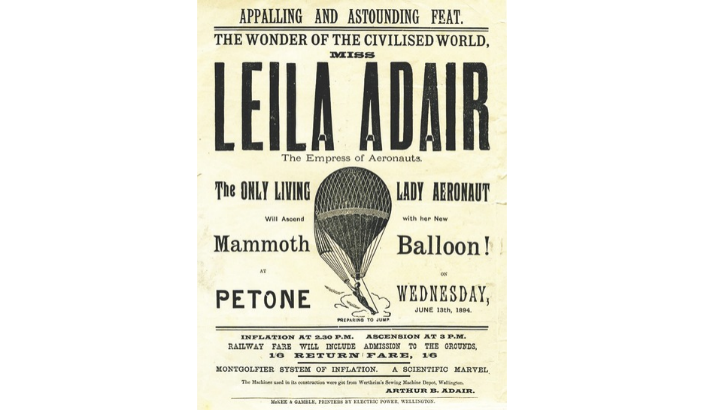
In July 1894, less than a year after New Zealand made international headlines by granting women the right to vote, thousands of locals gathered at Waterlea Park in Blenheim. They were not there for a political rally; they had all paid a shilling to witness a radical gravity-defying spectacle headlined by the self-styled “Empress of Aeronauts” - Miss Leila Adair.

Adair was an international sensation, an “American Daredevil” whose real identity was later revealed to be Lillian Hawker, an Australian single mother of two children, who was set on defying Victorian societal expectations for women.
Standing before the Blenheim crowd, her attire alone was a strong political statement. She wore a short-sleeved blouse, tiny bloomers, and pink silk tights – a shocking departure for the norms of good society, signalling the absolute physical freedom of the emerging “New Woman” movement.
The main event was pure adrenaline. Using the Montgolfier brothers’ process, a massive 84-foot canvas balloon was inflated with hot air over an open fire trench. Once ready, the lines were cut and the balloon shot skyward over the Marlborough landscape. Miss Adair didn’t hide in a basket, she hung completely exposed from a trapeze bar suspended underneath the balloon.
Given that her tour was plagued by narrow escapes, including a terrifying incident in Hamilton where her balloon burst mid-flight, the crowd watched with bated breath. She launched into a sequence of breathtaking, slow-motion acrobatics directly on the swinging bar. She hung upside down suspended by nothing but her knees and then her ankles, entirely silhouetted against the sky.
With the balloon rapidly losing its hot air, she had to quickly prepare to get back to earth. Navigating the sinking craft away from the town’s buildings, she rode the exposed trapeze rigging all the way down, bracing herself as the massive canvas structure swept over the countryside.
The flight ended with a rough but successful touchdown in Mr Pike’s paddock on Manse Road (now Main Street).
Today as we look back at the fight for gender equality, Leila Adair’s flights remain a powerful visual metaphor.
Long before aeroplanes took to New Zealand skies, this audacious aeronaut proved that women were ready to conquer new heights.
