
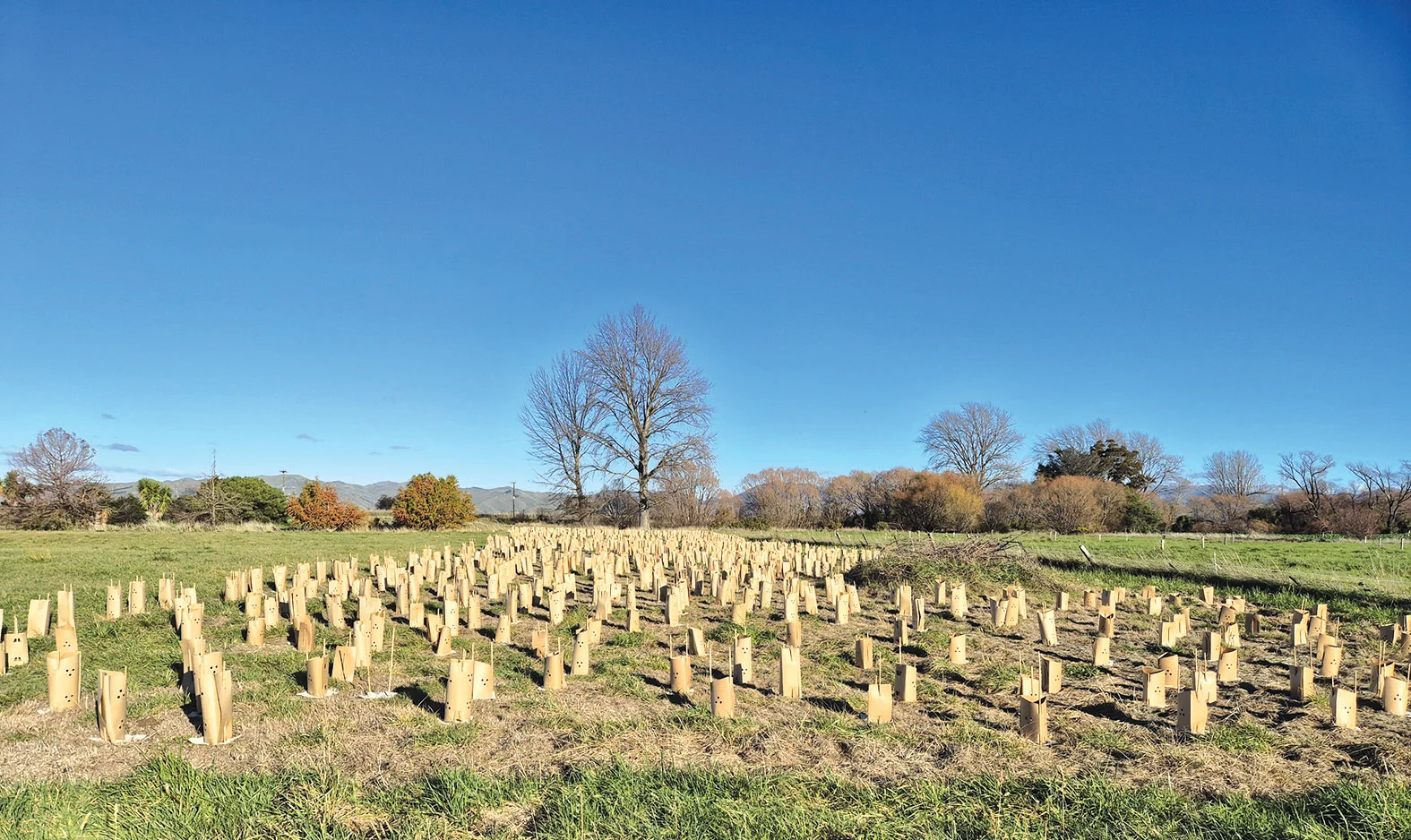
Can a firebreak also deliver biodiversity, flood resilience and landscape amenity? The Wairau Nature Network is putting that idea to the test at Thomsons Ford Reserve.
By establishing a 10m-wide green break, the team is trialling low-flammability native species as an alternative to more flammable nurse plants such as kānuka, helping reduce wildfire risk near urban areas.
During winter, volunteers planted 1000 eco-sourced trees, including marbleleaf, lancewood, five finger, karamū and kanono. The approach focuses on moisture-retentive species with supple leaves that form a dense canopy, reducing fuel loads and acting as a natural “spark arrestor”.
All trees were fitted with cardboard guards and EcoWool mats, while larger-leaved species received frost-protection spray.
Just three weeks later, the project faced a setback when the Opaōa River surged from less than 1m³/s to more than 400m³/s in six hours. The flooding stripped topsoil, exposed roots and swept away tree guards before heavy frosts arrived soon after.
Volunteers responded within three days, rescuing and replanting about 75% of the trees.
Despite the difficult start, results have been encouraging. Marbleleaf recorded a 100% survival rate, while lancewood, karamū, five finger and several donated wineberry plants also showed strong resilience.
Kanono proved less successful, demonstrating the need for an established canopy to provide frost protection.
The project also highlighted the value of establishment protection. Trees that received frost spray and guards performed significantly better than unprotected plants. Organisers say the frost spray costs about 5c per tree and can make a substantial difference to survival rates.
Infill planting will continue with the strongest-performing species before more sensitive, low-flammability plants are introduced in later stages.
The group recommends that landowners in high fire-risk areas consider green firebreaks to help protect infrastructure and native forest remnants. Restoration practitioners are also encouraged to increase the proportion of low-flammability species in their planting programmes.
The full report can be found wairaunaturenetwork.org.nz/news
