
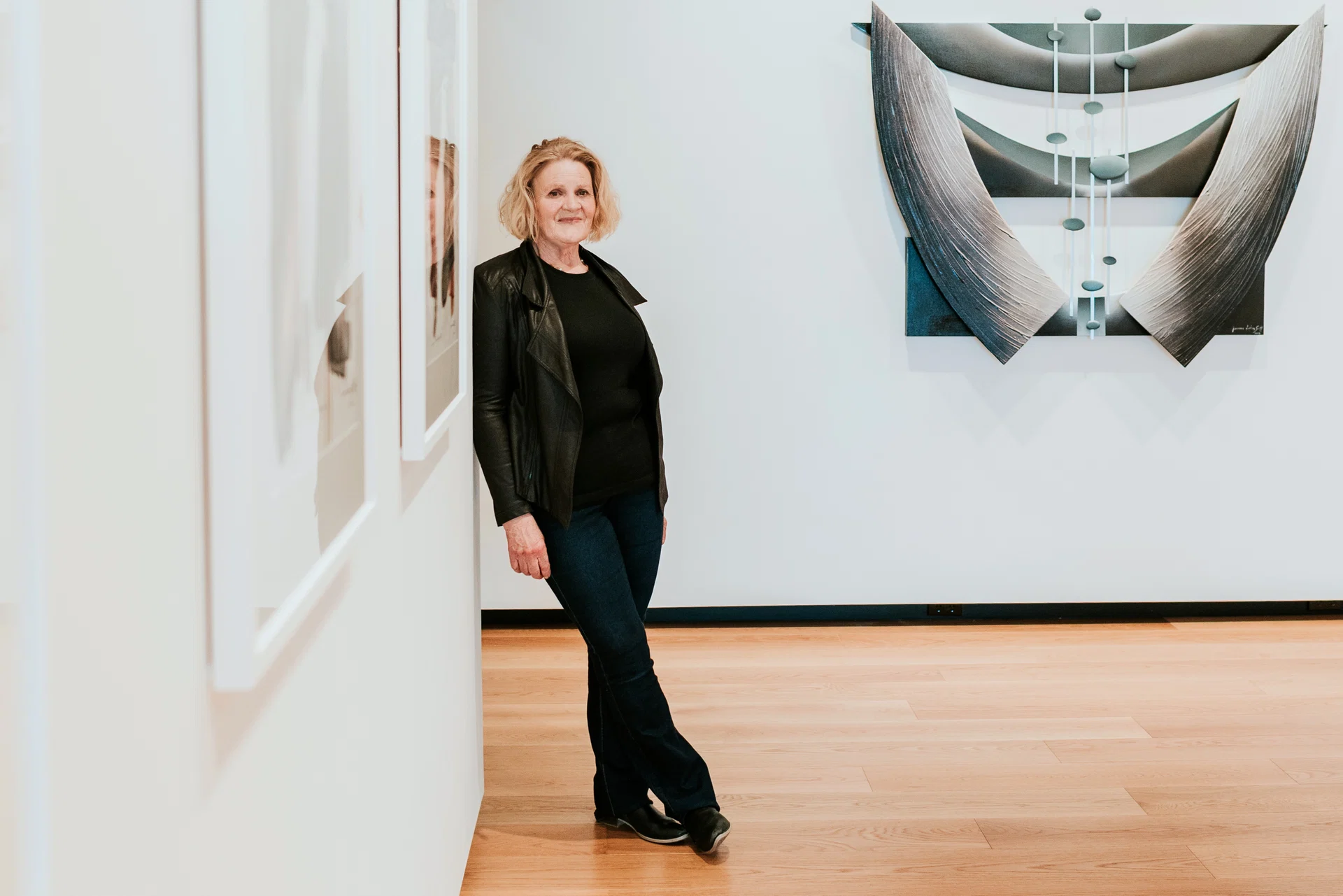
Joanna Dudson-Scott began her professional life as an artist ‘terrified in a little shed,’ wondering what she was doing. Twenty-five years later, she has just opened her twelfth solo exhibition. Joanna shares how her deep connection to the Wairau River has shaped her work and inspired a collection tracing the braided waterways of the South Island.
Words: Alistair Hughes | Photos: Aimée Preston
Entitled Wairau-Waitaki Return: A Braided Journey, Joanna Dudson-Scott’s latest exhibition will run until 22 November at Marlborough Art Gallery Te Kahu o Waipuna.
“It’s 34 new works, based on the braided rivers of the South Island”, she explains. “Our braided rivers are pristine and very rare in the world, and need to be looked after, I believe.” Joanna was inspired to incorporate and depict our east coast waterways for this collection during her travels between Marlborough and visiting family in Otago over the past few decades, as she crossed the Waimakariri, the Rakaia, the Rangitātā and the Waitaki. But the river which has her heart is the one she now lives next to: the Wairau.
“When I’ve needed some space and time, I've often gone down to the riverbed and just sat among the stones,” she says. “It has a fantastic peacefulness to it, and there's an awful lot of life, even in stones. People don't realise that they are pretty much ‘crystals of the river’, and it's amazing how contemplative it can be down there.”
Joanna says she hopes the exhibition will help people learn more about the rivers, while allowing her to express her passion for them and leave a record of their appearance and significance for the future.
A family holiday in the late 1980s first brought her to Marlborough.
“My partner and I could not believe, compared to Dunedin, how warm it was up here,” she recalls. “I used to knit all these little woolly singlets to keep my children warm, but it was a different climate here, the light was different, and it was beautiful.”
Finding work, they stayed because the outdoors-loving couple had never found another place which offered such a variety of activities.
“Skiing, boating, White’s Bay, you name it. We're cyclists, with an entire valley we can cycle around, and there are tramping tracks up every mountain here. And you don’t have to walk far to be in total solitude.”
Joanna drew on her Otago University Art School training and gained a qualification at a local polytechnic to teach art to adult learners, but her relationship with painting was eventually to surface in a more personal way. The catalyst sadly turned out to be the too-soon loss of someone dear to her.
“That's when I took the step because it was very profound losing a friend so early in life. It makes you reflect. And I thought: ‘Do you know what, Jo? Life’s too short, and if you're going to be an artist, you need to get on with this.’”
She admits leaving her job to become a full-time artist was scary, but it also felt like picking up again where she had left off, to decide what her life was about.
In choosing what to paint, she drew on her earliest memories.
“My father was a farmer, and he always loved the landscape. He was always telling me, ‘Look at these hills, look at that sky… what can you see?’ I just described it to him because he always wanted to know that from me, so I guess it was a language first.”
Although Joanna’s father was not an artist himself, it ran in the family with his own aunts having painted in the past. “I was given drawing tools and materials and he encouraged me to go to art school,” she recalls. “He has passed away, but even now, when I'm walking in the hills, I almost have an experience of carrying him with me. It’s as if he wants me to look at things so he can see them – those connections are really strong.”
Joanna maintains that the landscape of Marlborough provides endless creative stimulation.
“One of the main things that inspires me is the intensity of the blue hills at certain times. I don't think I've experienced anywhere else the violet blue that happens here during that quarter light before the sun goes down on a spring or autumn evening, and it just ‘turns’.” She says that the colours of the landscape here are magical. “The way the light washes over to create the most intense greens and yellows and blues – it's just beautiful, isn't it?”
To capture this unique depth of colour, Joanna is a lifelong advocate of painting in oils.

“Some people get very exasperated with oils and don't understand them, they find them messy. But I have never left oils because, as I've found with my work, you can have eight layers of oils on a canvas, and each colour breathes through and becomes alive.”
She can respect other techniques, but over the years has made a considerable investment in what she refers to as ‘a huge smorgasbord of colours and paints.’
“I know my brand and I know my colours,” Joanna says. “So I'm an oil painter, and I have been ever since I left art school.”
Her work doesn’t simply record our own and sometimes other region’s distinctive shapes, light and colours – she has also pioneered a way of abstracting the landforms which enhances their splendour and echoes the way we perceive our surroundings.
“My work became constructional plus compositional colour. I was working hand-laid river silt into the work as well, and that layering and abstraction is my signature style. Colour is about light and how we see it. So all I'm doing is taking that and making it physical.”
Joanna has also branched out into three-dimensional sculptural pieces, particularly in this current exhibition – using magnets to construct some of her compositions.
Her love for our landscape and particularly the Wairau River manifested in an even more direct way when she joined other creatives and conservationists in 2009 to oppose the proposed Trustpower hydro-electricity scheme, which would have fundamentally altered the health and nature of the river.
“I was part of a group of environmental artists who raised money to help Save the Wairau, a body of people who wanted to fight for the life of the river. That's when I found out from Forest and Bird and Fish and Game how precious the river was, and what it held for people and wildlife that don't have a voice for themselves.”
Save the Wairau’s efforts helped to stall the project, which was eventually abandoned when consents lapsed in 2021.
With the future of the river secured, Joanna undertook a very personal study to help create her current exhibition.
“I went with my daughter right up to Lake Rotoiti and into the Molesworth Station and the Rainbow Valley, very close to the source of the Wairau, and we camped there, just to get a feeling for where it started.” Joanna marvelled that a river which can swell so formidably during floods (what she refers to as ‘becoming angry’) can almost be stepped across at its source, barely a metre wide.
“Then during Matariki, I took a walk out to the Wairau Bar where the water empties into the ocean. So I've been from one end to the other, and it was an adventure and a spiritual journey for me, really.”
Joanna’s affinity with winding and braiding rivers can be seen reflected in her ever-evolving style. “I know there are artists that you can recognise from forty years ago with the same work,” she says. “But I am a believer that we are not who we were twenty years ago. Our experiences are the things we grow with.”
She maintains that this also informs her growth as an artist, to progress and innovate. “And so my work will grow as I move forward and try new things. But as somebody said, ‘it's always you, Jo’, I’m still recognisable within those changes.”

Wairau-Waitaki Return: A Braided Journey has been three years in the making, and Joanna believes that she has experienced significant self-discovery through her exploration of its themes.
“I have felt very much at home with what I'm working on, and I think, as people we all need to keep learning. We are lifetime learners of all sorts of things, and it's really important that this is reflected in what I do.”
