
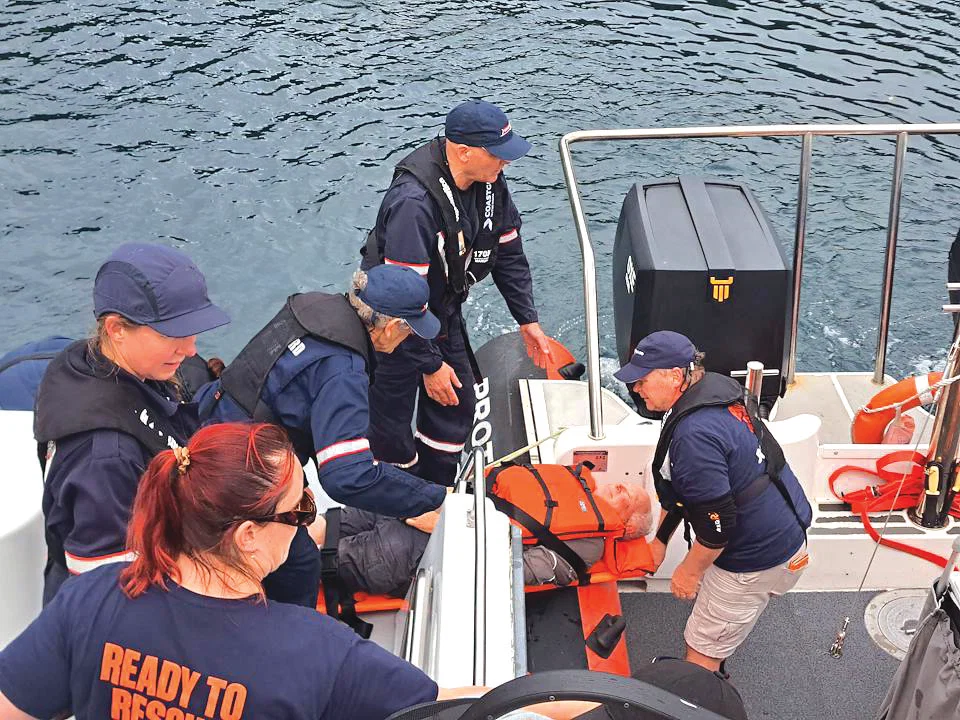
Fake yet convincing screams echoed around Kumutoto Bay on 7 November when dozens of actors put Coastguard crews to the test in a mass casualty exercise.
More than 80 Coastguard volunteers from Taranaki to Sumner took part in the training event (called Trainex), alongside St John crews, and Police Search and Rescue teams.
“This is where we learn, this is where we try and put a real-life scenario into practise, so when it does happen we are ready,” said Tasman District search and rescue assistant co-ordinator Aimee MacDonald.
She was among the 50-or-so actors in the final, major exercise, which started on Marlborough Tour Company’s vessel Odyssea.
The scenario: the boat’s hit something, there’s been a fire, and it’s now sinking. Many of the passengers and crew are injured (complete with fake blood and burns), some remain onboard, some are missing, one is swimming, and many more are on a nearby beach.
Tracy Jowers’ cries could be heard across the Bay. She knew the value of the exercise from her 16 years with the fire service and five with ambulance.

“You can’t learn without having real hands-on experience,” she said. “Scenarios are how you learn, classrooms not so much. Hands-on, someone really screaming, someone really hurt.”
Coastguard Marlborough’s Ryan Spence was the on-scene commander on Nelson’s Sealord Rescue: “All we had was that there was a report of a ferry with 50 persons onboard that was sinking. It was a lot to take in… it was all a bit of a mind game,” he said. “I was fortunate enough to have some really good crew.”
It was about safely exposing volunteers to “the extreme scenario we’ll hopefully never have to deal with,” said operations support for Coastguard’s Hauraki units, Victoria Clements.
Dane Robertson, manager of operations support for Coastguard’s central region (from the top of Coromandel down to Wellington), said, “when you come together, you’re putting faces to names, getting to know other units’ vessels, ‘cos each vessel differs, and it builds a confidence and trust in each other in knowing that you can work together”.
Dion Reardon, overall co-ordinator of the weekend for Coastguard, said the training weekend involved 11 coastguard vessels and two jetskis.
Volunteers came from Taranaki, South Taranaki, Whanganui, Foxton, Mana, Kapiti Coast, Wellington, Nelson, Marlborough, Kaikoura, Sumner, Canterbury, and Lake Brunner, he said.
Caleb Winn, from Picton said, “I’m bloodied up, cos I’ve got a crushed hand, I’ve scratched myself”.
Linda Wines, who’s been living in Picton less than a year, said “[I’ll be] as difficult as I can be,” for the Coastguard crews.
She was taking part because, “it’s a really good cause and I just thought it’d be a lot of fun and a good chance to meet different people,” she said.
Toni Rigarlsford (not Rigarlsholden, she quips) said “she’d heard there was a good free trip going out on the Sounds. Coffee, chocolate, so we came along.”
She’d come up with partner Kevin Rigarlsford from Kaikoura where he’s been a Coastguard volunteer for five years.
The exercise was “an amazing opportunity to have so many units working together around the country,” he said. For the likes of our [Kaikoura] unit, we’re quite isolated. We’ve got 100 miles either side of us, so the opportunity to work with other boats and other teams is really important.”
