
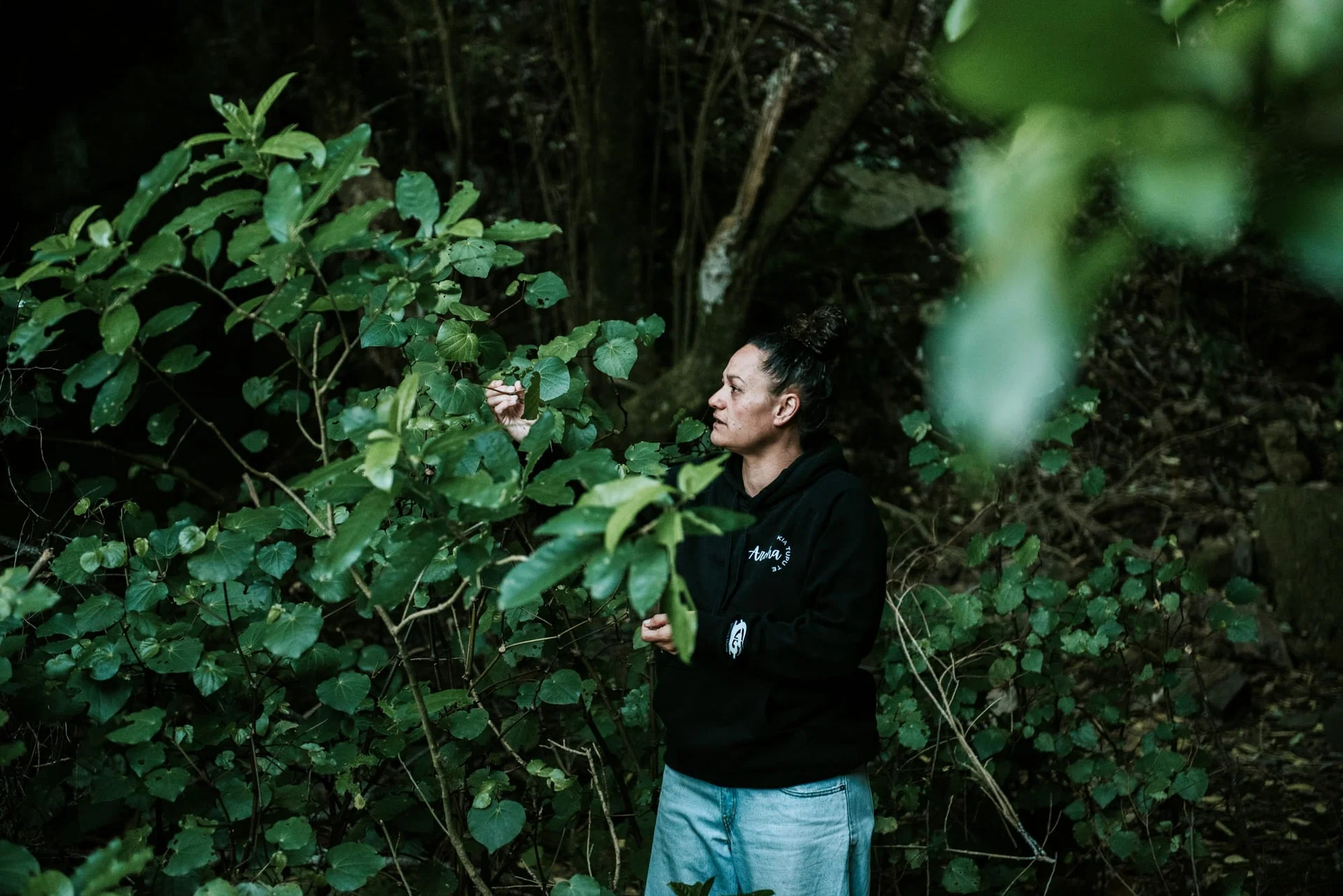
For Ripeka Hook, learning traditional rongoā medicine has strengthened ties to her culture, restored plant knowledge across generations and taught her to see the natural world with new eyes.
Words: Britt Coker | Photos: Aimée Preston
What should be a short 10-minute walk beside the Pelorus River can take a whole lot longer for someone like Ripeka Hook who sees the point of the meandering, not to reach the end, but to meet with others on the path.
“That walk there could take anywhere from two to three hours, depending on how much kōrero you do,” she says. “We’re used to being on a track in order to get to the hut that’s at the end of the track, or the bay. But we don’t notice everything that’s around us.” As a rongoā Māori practitioner, meeting with others means to kōrero with the native plants she discovers on the way. Not to just consider them as scenery or medicinal supplies, but as part of her extended whānau.
“That’s not a hebe over there. That’s my brother, the koromiko,” Ripeka explains. “They’re my older siblings, and in a whakapapa sense, they came before me. We see every living thing as having a mauri and a life force. It’s not meeting a plant. I’m meeting a person.”
The relationship comes before harvesting. “You can’t just learn it online, and you can’t just learn it off Facebook,” Ripeka says. “You need to learn how to connect with the things that are around you.” Kanohi ki te kanohi – face to face – matters. So does touching the plants, speaking to them, observing where and how they grow and understanding that the exchange is mutual. “They’re not actually there just to serve us,” she says. “We’re there to serve them just as much.”
That relationship shapes how she gathers. With kawakawa, for example, Ripeka respects the knowledge of the kawakawa looper caterpillar that leaves holes in the leaves. “The caterpillars know what leaves are the strongest, so we follow the caterpillars,” she explains. To her, a leaf that has been damaged and healed carries a lesson. “If a person has been attacked in some way, and you figure out a way to heal yourself, then you become a place of healing for others. It’s a bit the same with the kawakawa. Because it’s had to heal itself, now it’s a stronger healer.”
Ripeka first trained as a secondary school teacher in health and physical education. This was the life she was living in Australia with her family when her mother, Tricia Hook, asked her to return to Aotearoa and learn rongoā Māori from her and fellow mentor, Koka Lovey Walsh, so the knowledge could continue into another generation.
“She said, ‘You need to come and learn this before I forget it,’” Ripeka recalls. So, with her husband and sons (six months pregnant with her youngest), she packed up and returned home. Her mother had been an aromatherapist since Ripeka was 12, and over the ensuing years additional complementary therapies were added to Trish’s skillset. Then, in the years that Ripeka was living in Australia, Trish extended her knowledge to rongoā and miri miri (massage). Finally, she felt it was time to pass the knowledge on and Ripeka recognised that too. “I feel this is my purpose. It's like, this is where I should be.”

Ripeka recalls her first rongoā walk with another of her mentors, Pā Rōpata Rob McGowan, a highly respected rongoā Māori practitioner and teacher, spending three hours together in the bush at Onamalutu Scenic Reserve. “For me, it was like I was meeting my friends again,” she says. The kōrero stayed with her, but the learning also felt familiar. Later, when she learned traditional miri miri, she felt that using it in practice alongside rongoā was drawing all the threads together.
Back in Aotearoa, rongoā soon became part of everyday family life and early experiences taught her four sons to trust in the power of native plant medicine. She recalls how shortly after the family returned to Blenheim in 2018, her eldest son developed a severe toothache. Trish gave him kawakawa to help him through the night before he could see a dentist the following day. That experience gave later encounters with rongoā “a positive spin” for the children, where they learned to trust and respect the native plants for their medicinal benefits.
Her children have also seen how quickly plant knowledge can matter on the road. Once, while bringing her children home from Kaikōura, she watched them demolish a bag of lollies before leaving. Soon, they were complaining of stomach aches and car sickness. Ripeka stopped, found koromiko and carefully took clean growth from the centre of the plant for them to chew on. “It was only a tiny little bit, and that was them ready to go,” she says.
Those experiences are part of a wider family practice. Ripeka has used rongoā to support her children with eczema, as well as her husband for two years, post-injury. Her sons are still young, but they know how to identify and gather familiar plants, use kawakawa and make basic first-aid plasters. The goal is not to make each of them a practitioner. It is to make the knowledge part of the everyday life again – there when they need it, as it once was for all Māori.
“Rongoā is about empowering myself to look after myself and my whānau,” Ripeka says, explaining that this principle sits alongside mana motuhake and tino rangatiratanga – the ability to make informed choices about health and wellbeing without automatically outsourcing every minor concern. For several years, Ripeka provided rongoā as an ACC practitioner and, over the years, observed an increase in the number of people interested in using rongoā for treatment. Yet Ripeka resists reducing rongoā to a list of plants matched to symptoms. “Rongoā is not treating ailments,” she says. “We start with the person.”
“For us, there was such disconnection from the spiritual realms; we weren't allowed to access them for a long time, and that disconnection is one of those things that manifests as illness, whether that's disconnection from whenua, so land, or disconnection from faith and spiritual belief. Either way, that is not healthy for people. So we're looking at all of those aspects, but especially wairua. Karakia is where we start always, and karakia is wairua, that is engaging the wairua element, that spiritual element. So that's where it starts, and that again is a very different concept.”
Ripeka feels an added sense of significance in learning rongoā because the sharing of plant wisdom, mātauranga Māori, was deliberately disrupted early last century. Ripeka speaks plainly about the effects of the Tohunga Suppression Act 1907, a New Zealand law designed to criminalise and stop Māori healers (tohunga) from using traditional practices to treat disease. She reflects on the generations of Māori who were subsequently denied access to their own knowledge. As a result, she sees learning and teaching rongoā Māori as more than just professional work, but cultural amends. Reviving something incredibly important that was maligned and belittled. And through legalised suppression, was also saying something about the people who valued and practiced it.
In a curious case of coincidence, Ripeka is actually related to a politician who was involved in taking the Act to Parliament in 1907. “In helping to reignite the practice, it’s like I get to right that wrong,” she says. “It’s a generational thing that brings a sense of relief to my line, to my future lines.”
Ripeka taught rongoā locally through Manaaki Ngahere from 2018 to 2025. This year she has been teaching at tertiary level through Te Wānanga o Aotearoa, with students learning through weekly classes, noho marae (full immersion), full-day wānanga and online study. Moving from a heavily subscribed ACC practitioner back into education was a long-term and pragmatic decision. One practitioner could not meet the need, but a new generation of learners could deepen the knowledge base.
Although next year’s teaching is less certain, Ripeka is confident rongoā will carry her through, as it has with previous challenges.
Teaching also returns Ripeka to her first calling. As a young teacher, she wanted to help Māori children and whānau connect with learning. Now she sees how teaching adults can reshape generations. She notes that one former student’s learning drew her adult sons back towards hunting and fishing, and her grandchildren away from screens and into a hunter-gatherer way of life, more connected to the land. “It brings a reconnection to mātauranga Māori (knowledge) for kids because it changes their household.”

At home, that intergenerational picture is already visible. Ripeka and her family live with her parents, so three generations share the property, and often four will gather for Sunday meals. Her return to rongoā Māori cannot be separated from that way of living. It is knowledge learned from elders, tested in ordinary family moments and passed on to her children and students. The end result is not just a revival of plant medicine; it also offers a person a new way of looking at the natural world. After a slow rongoā walk where you connect with the plants you come across, Ripeka reckons, “you drive through the landscape of New Zealand with a whole new set of eyes that you never knew you had.”
Kawakawa (Piper excelsum)
A central plant in rongoā Māori and often a starting point for learners. Ripeka’s whānau has used kawakawa for toothache, minor first aid and aches and pains. Traditionally, it has also been used in preparations for skin complaints and digestive discomfort. Its cultural use extends beyond medicine, including tangihanga, so the harvesting place and kaupapa matter.
*Please note an incorrect image for kawakawa was published in Marlborough Magazine.
Koromiko / kōkōmuka (Veronica species)
A plant used for stomach upsets. Ripeka recalls using a small amount to help children suffering stomach ache and car sickness on a trip home from Kaikōura. Traditional accounts also describe uses for digestive complaints and topical applications. The original native variety is best but modern day hebe cultivars will still have an effect.
Plantain / plantago (Plantago major and Plantago lanceolata)
A widespread introduced plant often found in our own backyard. Its Māori name is kōpata, and it is found in all continents, often considered a weed. It may be used for swelling, burns, helping blood clot and respiratory support, as a plaster or poultice.
*Please note: Accurate plant identification is essential; some plants are toxic, and harvesting sites may be contaminated or sprayed. Learn directly from a knowledgeable practitioner and seek qualified health advice for persistent, severe or urgent symptoms.
